Best Photo Spots for a Tokyo City Tour: 7 Locations Worth the Shot
Most Tokyo photography guides list the same forty spots regardless of how you're actually getting around the city. This one doesn't. Every location below sits on the route of one of the ten guided tours compared on this site, so the question each entry answers is narrower and more useful than "where's a nice view": which tour gets you there, and what does the light look like when you arrive. A go-kart crossing Shibuya Scramble produces a different photograph than a coach window ever will, and the reverse is true too, so this guide sorts spot by format rather than pretending one itinerary covers all seven.
Quick answer
The single strongest frame on any Tokyo city tour is the Kaminarimon gate's giant red lantern with the Nakamise crowd receding toward Senso-ji behind it, a stop shared by the half-day Hato Bus and the full-day coach. Six more spots round out the set, from the Shibuya Scramble to the neon of Kabukicho, and which Tokyo city tour passes each spot decides more of your shot list than any camera setting does.
Key takeaways
- Kaminarimon gate and Senso-ji's Nakamise lane is the strongest single frame, reached on the Hato Bus and the full-day coach
- All seven spots, and the exact tour that reaches each one, are mapped further down this page
- Tokyo Tower's Main Deck sits at 150 metres; the Skytree's Tembo Deck runs 340 to 350 metres, a different shot from a different tour
- Morning suits most stops; the Shinjuku walk and an evening go-kart slot are the two built around after-dark light
- The one shot no ground spot gives you is from inside the go-kart crossing the Scramble itself
The 7 Photo Spots at a Glance
Seven spots, the tour format that reaches each one, and the window of light worth planning around. Detail on every spot, including GPS and composition notes, follows in the numbered section below.
| Spot | Tour That Reaches It | Best Light |
|---|---|---|
| 1. Kaminarimon Gate & Nakamise | Hato Bus, full-day coach | Late morning, ahead of the lunchtime stall crowd |
| 2. Shibuya Crossing | Go-kart, Shibuya walking tour | Blue hour, just after sunset |
| 3. Tokyo Tower Main Deck (150m) | Hato Bus | Clear late-morning skies |
| 4. Skytree Tembo Deck (340-350m) | Full-day coach | Late afternoon, long shadows over the bay |
| 5. Meiji Shrine's Great Torii | Harajuku walking tour | The first twenty minutes after the shrine gates open |
| 6. Nijubashi Bridge, Imperial Palace | Hato Bus, full-day coach | Soft, overcast light on the moat |
| 7. Shinjuku & Kabukicho neon | Shinjuku night walk | After dark, the walk's first hour |
Four of the seven sit on a bus or coach route, two belong to a walking tour, and one exists only from inside a moving go-kart. That split matters more than it looks: book only the full-day coach and you'll never get spot 2 or spot 5, book only a walking tour and the Skytree deck stays out of reach. The map below plots all seven against each other so the overlap and the gaps are visible before you book anything.
Map of the Photo Spots
All seven numbered spots, colour-coded by the tour format that reaches each one.
The 7 Best Photo Spots on a Tokyo City Tour
1. Kaminarimon Gate and the Walk Up Nakamise
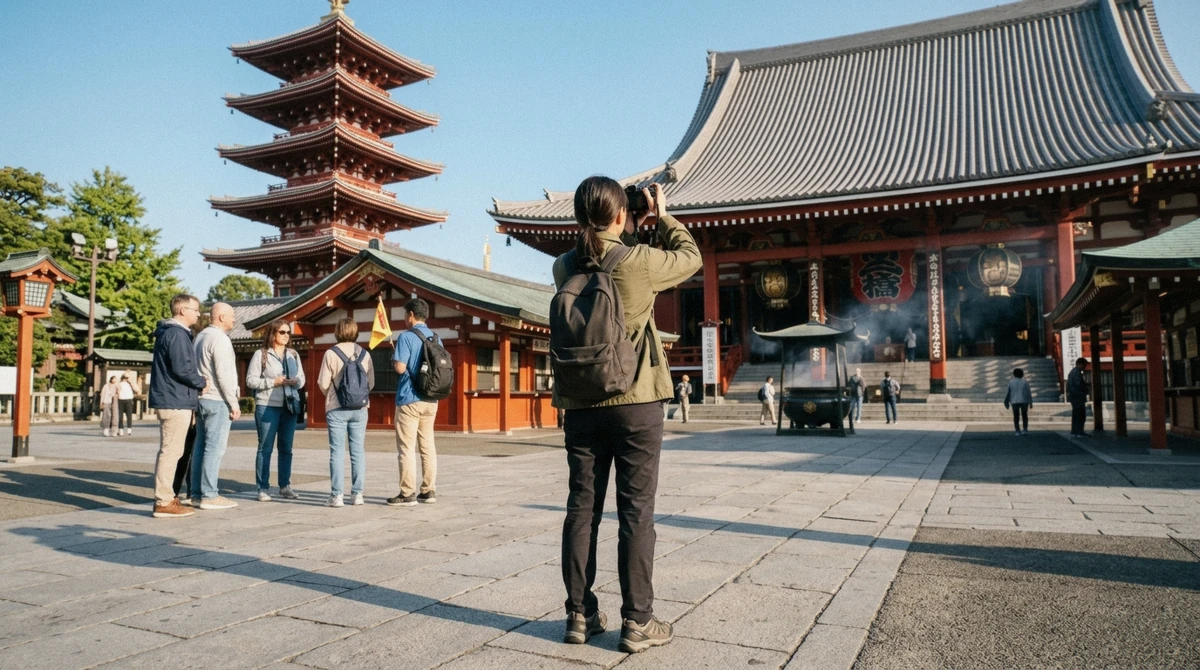
The shot is the gate itself: a five-metre paper lantern painted with the character for thunder, hung between two guardian statues, with the roughly 200 metres of Nakamise stalls and paper lanterns receding behind it toward Senso-ji. Kneel or crouch to put the lantern's calligraphy in the top third of the frame rather than shooting it straight on from head height, which flattens the whole scene.
The Hato Bus reaches this as its third and final stop of a four-hour morning, so plan for the stall crowd to have built by then; the full-day coach passes through mid-route, after its Asakusa matcha stop. Neither operator's own listing states a photography or tripod rule for the gate or the shopping street, so the honest guidance is timing and composition rather than a permit to plan around. The Hato Bus and full-day coach are the two tours that reach it.
2. Shibuya Crossing, From the Kart and From the Street
Two entirely different photographs live at this one intersection. From street level or an upper floor of the buildings ringing the Scramble, you're composing a wide shot of pedestrians crossing from every direction at once, best a few minutes after sunset when the screens overhead start to dominate the light. The Shibuya walking tour puts you here on foot with time to frame it properly.
From inside a go-kart, you're not composing anything, you're the subject: reviewers of that tour describe pedestrians waving, photographing and cheering as the karts cross. It's a different kind of photo spot entirely, and it's covered on its own further down this page.
3. Tokyo Tower's Main Deck, 150 Metres Up
The Main Deck frames the city through the tower's own red-and-white lattice in the foreground, which is the detail that separates this shot from any other Tokyo skyline photo: you can see the structure you're standing inside as part of the composition. Shoot toward Shiba Park and the bay for the cleanest sightline.
The Hato Bus includes Main Deck admission as its second stop of the morning, after the Imperial Palace and before Senso-ji, which puts you up there in late-morning light. No other tour on this site visits the Main Deck.
Two Decks, Two Different Shots
Tokyo Tower and the Skytree aren't interchangeable stops for a photo, since they sit at different heights, face different directions, and show up on different tours.
| Deck | Height | Reached On | Best For |
|---|---|---|---|
| Tokyo Tower Main Deck | 150 metres | Hato Bus | Skyline framed by the tower's own red lattice |
| Skytree Tembo Deck | 340 to 350 metres | Full-day coach | Wide bay view with Rainbow Bridge in frame |
4. Skytree's Tembo Deck, 340 to 350 Metres Up
The Tembo Deck spans three connected floors between 340 and 350 metres, according to Tokyo Skytree's own floor guide, and the shot worth composing here is the bay itself: Tokyo Bay and Rainbow Bridge on the deck's eastern side, with long shadows stretching across the water in late afternoon.
The full-day coach gets skip-the-line entry and roughly ninety minutes at the deck, positioned after lunch and the Senso-ji stop, which lands you up there in mid-to-late afternoon, close to the golden light the shot rewards. The Skytree itself also sells a paid "Commemorative Photography" service at the deck, separate from the tour and its own line to queue for.
5. Meiji Shrine's Great Torii and the Forest Approach
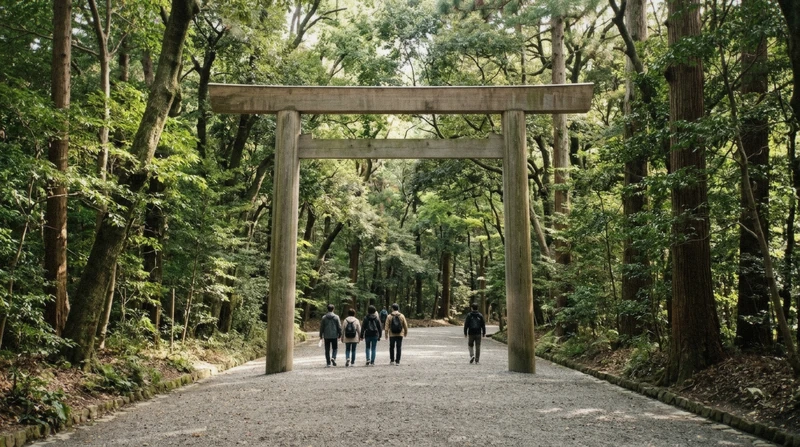
The wooden torii gate at the shrine's entrance is the shot: stand back far enough that the gate's full height fits the frame with the gravel approach path leading the eye through it into the forest. The wall of donated sake barrels a short walk further in is the second frame worth stopping for, better as a tight detail shot than a wide one.
The Harajuku walking tour spends its first forty minutes inside the shrine grounds, which is the biggest single block of time any tour on this site gives to one location. No stated photography or tripod restriction turned up on the shrine's own site, so treat the timing, not a posted rule, as the thing to plan around.
6. Nijubashi Bridge and the Imperial Palace Moat
The two-arched stone bridge reflected in the palace moat, with a corner watchtower behind it, is one of the most photographed single frames in Tokyo, and soft overcast light does it more favours than a hard midday sun, which blows out the water's reflection. Every tour and private guide on this site handles the Imperial Palace stop the same way: the outer garden only, never the inner grounds, since the Emperor's household still lives there.
Both the Hato Bus and the full-day coach stop at the bridge, typically early in their respective routes.
7. Shinjuku and Kabukicho After Dark
This is the one spot on the list where daylight ruins the shot rather than helping it. The Godzilla head mounted above Kabukicho's Toho building, the neon signage stacked floor over floor through Golden Gai's narrow lanes, and the lantern glow of Omoide Yokocho's yakitori alley all depend on the dark to read as anything more than ordinary storefronts.
The Shinjuku night walk covers all three in its first hour, before the group reaches the quieter stretch near Hanazono Shrine, which is the window worth prioritising if you're choosing where to spend your shots.
Photos From the Go-Kart: The One Shot You Can't Get on Foot
Be honest with yourself about what this tour actually gives you before you book it for the photos. Once the kart is moving, both hands stay on the wheel; nothing in the go-kart tour's own listing mentions a photo package or an included camera, and driving a road-legal vehicle across the busiest pedestrian intersection in the world is not the moment to be one-handed with a phone.
The real photo opportunity runs the other direction. Reviewers describe pedestrians waving, photographing and cheering as costumed karts cross the Scramble, so the shot you come away with is more likely to be someone else's photo of you than a photo you took yourself. If you want your own footage of the ride, mount a phone to the kart or your chest before the briefing starts, since there's no safe way to do it once the group pulls out.
Two moments do leave your hands free: the costume change at the Maruyamacho garage before the briefing, and the finish back at the same garage. Both are quick, ordinary photo stops rather than anything dramatic.
Night is the slot worth booking specifically. The operator's own route notes say the crossing, the screens and the Omotesando lights all work better after dark, and the karts themselves run lit. If the photo you actually want is one you compose yourself of the Scramble, the Shibuya walking tour gives you that with both hands free; the go-kart gives you a different kind of photograph entirely, the one where Tokyo is looking back at you.
Camera and Phone Settings for a Moving Tour
None of these ten tours build in tripod time, so the settings below assume you're shooting on the move, in a crowd, or through glass, not from a fixed spot with minutes to compose.
- Coach or bus window shots: shoot at an angle, not straight through the glass, to cut reflections; a faster shutter speed handles the vehicle's own motion better than image stabilisation alone
- Temple and shrine crowd shots: portrait or a moderate zoom beats digital zoom every time, since cropping in later keeps more detail than the phone's own digital crop does
- Any of the seven spots: brace against a rail, a post or your own chest rather than carrying a tripod, since a moving tour group has no built-in pause for setting one up
- Kabukicho and Golden Gai after dark: switch to night or low-light mode before you arrive rather than fumbling with settings once you're in the alley, and expect flash to wash out the lantern colour rather than help it
- Skytree's Tembo Deck: shoot at an angle to the glass here too, and bring a lens cloth, since fingerprints on the deck's own glass show up in nearly every straight-on shot
Which Tour Gets You to the Most Spots
No single tour on this site reaches all seven spots, so the honest question is which combination covers the most ground for the fewest bookings. The Hato Bus alone reaches three: Kaminarimon and Nakamise, the Tokyo Tower Main Deck, and Nijubashi Bridge, all inside one four-hour morning. The full-day coach adds the Skytree deck to two of those same three.
Between them, a walking tour picks up Shibuya Crossing and Meiji Shrine's torii, and the go-kart is the only way to the seventh.
None of this replaces knowing the calendar. Rain, haze and the season all change what these seven spots look like far more than any camera setting does; the month-by-month breakdown of Tokyo's weather covers which windows actually deliver clear light. And not every spot on this list needs a tour at all: Shibuya Crossing, Meiji Shrine and the Imperial Palace's outer garden sit open to anyone sightseeing Tokyo on their own.
What a tour buys you here is the Skytree deck, the kart's crossing, and a guide who already knows which forty minutes to spend where.
Frequently Asked Questions
Can I take photos during a Tokyo city tour?
Yes, on all ten tours compared on this site, with one practical exception: the go-kart tour keeps both your hands on the wheel once the group moves, so photography there happens through a mounted phone or camera, not a handheld one.
What's the best time of day for Tokyo tour photos?
Late morning for the temple, tower and palace stops, before the crowds and, in summer, the heat both build. After dark is the exception: the Shinjuku night walk and an evening go-kart slot are both built around neon and lit streets that daylight doesn't show.
Should I bring a real camera or just use my phone?
A phone handles all seven spots fine in daylight. A camera with a wider lens earns its weight in two places specifically: Kabukicho's low light, where a phone's digital zoom degrades fast, and the Skytree deck, where a wider lens copes better with the glass than a phone's default focal length.
Do any of the tours include a photo service?
None of the ten confirm one on their own listings. The Skytree itself sells a separate paid "Commemorative Photography" service at the Tembo Deck, but that's the venue's own add-on, not something bundled into the full-day coach ticket.
Can I get these photo spots without booking a tour?
Five of the seven, yes: Shibuya Crossing, Meiji Shrine, Kaminarimon and Nakamise, the Imperial Palace's outer garden, and Shinjuku all sit on open public ground reachable on your own. The Skytree deck needs its own paid ticket regardless of how you get there, and the go-kart's crossing shot exists only on that tour.
Are tripods allowed at these spots?
No stated tripod ban turned up on the official sites for Senso-ji, Meiji Shrine or the Skytree at the time of writing. In practice it rarely matters: none of the guided tours here build in time to set one up, so bracing against a rail or post is the faster, more realistic option on a moving itinerary.