 Tokyo City Tours
Tokyo Walking Tour: Imperial Palace, Asakusa, Shibuya and Harajuku
A Tokyo walking tour now covers four districts, not two: Shibuya, Harajuku, Asakusa and the Imperial Palace East Gardens, with shared walks from $13.04 per person for two hours. Free tip-based walks and private guides sit on the same ladder, so a first-time visitor can pick a price and a district in one place. The sections below set out what each route covers, where it meets and the catch on every listing, from the guide who will not wait for latecomers to the palace grounds you register for separately. For the coaches, private cars and bikes, compare TokyoCityTours.org.
Free and Tip-Based Walking Tours
Several operators run Tokyo walks at no set price, living on tips instead of tickets. They are the cheapest way to get oriented, with a few rules to know first.
Who Runs Free Walks
Tokyo Localized runs a free 3-hour walk from Akihabara to Ueno, with tipping encouraged, and Time Out notes that booking is required for all its tours, free or paid. Tokyo Free Walking Tour states its tours are completely free, run in small groups with multiple guides, booked through a calendar, with free cancellation anytime. Against that, a paid walk like the Shibuya crossing route costs $20, gives a fixed seven-stop route and a meeting point at Sabon on the third floor of Shibuya Mark City.
- Booking is required for free walks, just as for paid ones
- On Tokyo Localized's free Shinjuku night walk, tipping is optional with the amount up to you
- That walk charges no cancellation or no-show fees
- Groups are capped at 5 people per booking, and 6 or more must book private
When a Paid Walk Beats Free
A paid listing states its route, duration and meeting point before you book, so there is nothing to estimate. The Asakusa and Senso-ji walk at $24 names every stop from Kaminarimon to Azuma Bridge. The Imperial Palace East Gardens walk is listed as wheelchair accessible, which the free walks do not state. For the after-dark version of a free walk, see the Shinjuku night walks.
Source: Tokyo Localized, Tokyo Free Walking Tour, Time Out Tokyo.
Quick answer Shibuya or Harajuku, price, size and the catch
A Tokyo walking tour costs $13.04 to $24 per person for two hours in a group of up to 12 or 15. The Shibuya and Harajuku walks are $20 each, the East Gardens walk is $13.04 and the Asakusa walk is $24. The catch: the Shibuya meeting point inside Mark City is hard to find, so allow extra time.
Key takeaways
- The Harajuku and Meiji Shrine walk is the one to take first. It rates 5.0 from 139 reviews, and the $20 price covers the guide only.
- The Shibuya Crossing and back-street walk covers seven stops and finishes at the Hachiko statue.
- The two districts sit one train stop apart, so doing both on the same day is easy.
- July and August run above 30°C. The best time for sightseeing in Tokyo shows which months suit two hours on foot.
- After dark, the Shinjuku night walk uses the same small-group format at $20.
About the East Gardens Walk
Full refund up to 24 hours before the start time
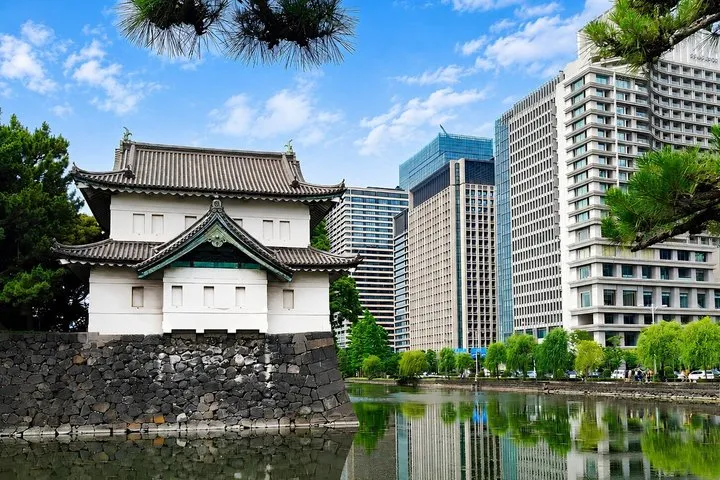
Stone gates and the remains of Edo Castle in the Imperial Palace East Gardens
The price covers the guide only. No ticket is listed in it
Small group with an English-speaking guide
The listing does not name it. It is confirmed once you book
Listed as wheelchair accessible. Easy, suitable for all fitness levels
Check Dates for the Imperial Palace East Gardens and Edo Castle History Walking Tour
Pick a date to see the price and the start times the operator has free. From $13.04 per person, 2 hours, rated 4.9 from 3,343 reviews.
You'll confirm the exact date and time on the secure booking page.
Which Walk to Take
Shibuya: the crossing and what surrounds it
Most visitors photograph the Scramble and leave. This walk uses it as one stop out of seven and spends the rest of the two hours on what sits around it.
It starts inside the station at Taro Okamoto's mural Myth of Tomorrow, a painting of the atomic bombings that was made in Mexico, lost for decades and rehung here. Then the crossing itself, then Miyashita Park, the elevated deck with a skate park and climbing wall built over the old ground-level green space.
After that the walk narrows: Nonbei Yokocho, two lanes of bars so small some seat four people, then the shops and noise of Center-gai, then Maruyamacho, Shibuya's former red-light district and now a live-music quarter. It finishes at the Hachiko statue with the story of the dog who waited at the station for nearly a decade after his owner died in 1925.
It rates 4.9 from 178 reviews.
Harajuku: the shrine and the fashion street
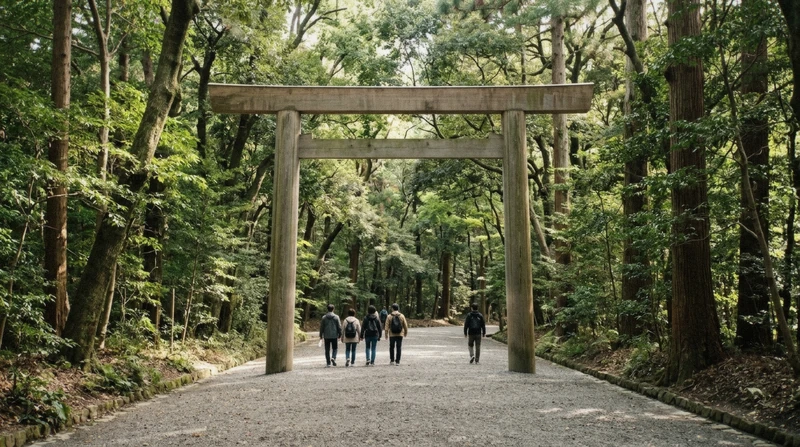
The other walk starts at the JR Harajuku West Exit by the NewDays store and goes straight into Meiji Jingu, past the first torii gate and the sake barrels.
That matters, because the shrine rewards explanation. Built in 1920 for Emperor Meiji and Empress Shoken, it sits in a planted forest of about 70 hectares, as the shrine's own site sets out. The guide covers the shrine's history and the wall of donated sake barrels that everyone photographs without knowing why it is there.
Then Takeshita Street, 400 metres of crepe stands, cosplay shops and limited-edition sneakers, and Omotesando, the wide ginkgo-lined avenue with buildings by Tadao Ando, Kengo Kuma and Herzog and de Meuron.
It rates 5.0 from 139 reviews, the $20 price covers the guide only with no ticket listed, and the route is listed as wheelchair accessible.
If you only take one
Take Harajuku first. The shrine is the piece of Tokyo that most needs a guide, and the contrast between a silent forest and a 400-metre lane of teenage fashion a short walk apart is the fastest way to understand the city.
Take Shibuya if you have already seen the shrines and want the parts of the district that do not appear on postcards. Reviewers keep saying the same thing about it: they went into streets they would never have found.
Both cost $20 per person, both run two hours, and doing both on the same day is easy since the two districts sit one train stop apart.
More Walks: Imperial Palace, Asakusa, Ueno and Yanaka
Two more districts join Shibuya and Harajuku on this page: Edo history at the palace and old Tokyo in Asakusa. Ueno and Yanaka remain free-walk territory.
Asakusa: Old Tokyo on Foot
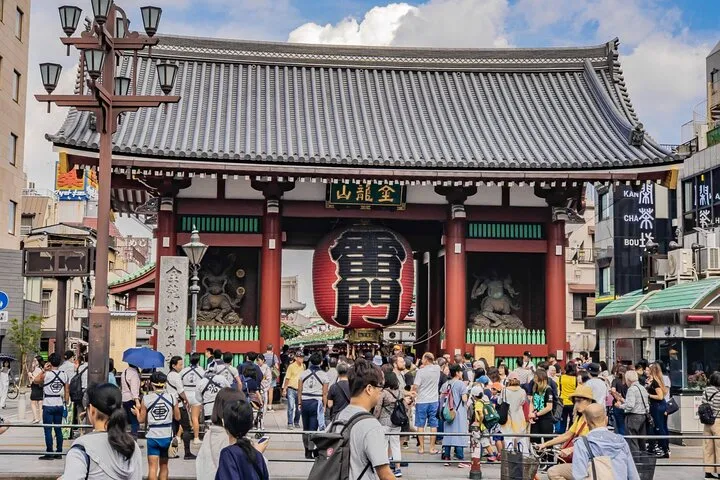
The Asakusa and Senso-ji Old Tokyo Walking Tour covers seven stops in two hours: Kaminarimon Gate, the Nakamise shopping street, Senso-ji, Asakusa Shrine, Hoppy Street, Denboin street and Azuma Bridge. It meets on the left side of Kaminarimon, near the Tokiwado Kaminari-okoshi shop, and ends near Azuma Bridge. Ages 0 to 17 book at the child rate.
The catch is the same as in Shibuya: the guide cannot wait for latecomers.
- Tokyo Free Walking Tour also walks Asakusa: Kaminarimon, Nakamise, Senso-ji, Asakusa Shrine and a 2-hour Hanayashiki and Hoppy Street route
- Its other free routes cover Ueno Park and the Toshogu shrine, Yanaka and Nezu with Yanaka Ginza, Nezu Shrine and cat sculptures, and the East Gardens
- Tokyo Localized sells a 2-hour paid Asakusa walk around Senso-ji, Kaminarimon and Nakamise
Edo History at the Palace
The Imperial Palace East Gardens and Edo Castle History Walking Tour is the cheapest guided option on this page at $13.04 per person, in groups of up to 15. It stays in the public gardens among stone gates and the remains of Edo Castle. The gardens are free to enter on your own and close every Monday and Friday.
The meeting point is not named in the listing and is confirmed after booking.
- Pick Asakusa for old Tokyo and temples
- Pick the palace for Edo Castle history at the lowest price
- Pick Shibuya or Harajuku for youth culture and the shrine forest
Districts Others Walk That Cost Nothing Here
Ueno Park and the Yanaka and Nezu lanes do not appear on any of the four walks sold on this page. Tokyo Free Walking Tour covers both, free of charge, alongside its East Gardens route. If a Yanaka trip matters to your plans, a free walk or a self-guided day is the way to cover it.
Source: Tokyo Free Walking Tour, Tokyo Localized, Imperial Household Agency.
Tokyo Walking Tours Compared
Two hours each, from $13.04 to $24 per person, all guided in English with free cancellation up to 24 hours before the start.

Shibuya Crossing and Hidden Streets Walking Tour
A 2-hour guided walk through Shibuya in groups of up to 12: the Myth of Tomorrow mural, the Scramble, Miyashita Park, Nonbei Yokocho, Center Gai and the Hachiko statue. The price is all fees and taxes. Tips and food are extra.
- Cancellation
- Free cancellation 24h
- Operator
- Localized Walking & Food Tours
Harajuku and Meiji Shrine Guided Walking Tour
A 2-hour guided walk from the Meiji Jingu torii gate through the shrine forest to Takeshita Street and Tokyu Plaza, in groups of up to 15. The price is the guide only. Tips and food are extra.
- Cancellation
- Free cancellation 24h
- Operator
- Localized Walking & Food Tours
Imperial Palace East Gardens and Edo Castle History Walking Tour
A 2-hour guided walk through the Imperial Palace East Gardens and the remains of Edo Castle, in groups of up to 15. The $13 price covers the English-speaking guide. The meeting point is sent after booking.
- Cancellation
- Free cancellation 24h
- Operator
- Traveling Tokyo
Asakusa and Senso-ji Old Tokyo Walking Tour
A 2-hour guided walk through Asakusa in groups of up to 12: Kaminarimon, Nakamise, Senso-ji, Asakusa Shrine, Hoppy Street and Azuma Bridge. The price is the guide and commentary. Food and tips are extra.
- Cancellation
- Free cancellation 24h
- Operator
- Localized Walking & Food Tours
Shibuya and Harajuku Side by Side
The four walks compared on price per person, group size, meeting point and the stretch each is built around, from the live listings.
| Walk | Price | Group | Meets at | Best bit | Book |
|---|---|---|---|---|---|
| Shibuya back streets | $20 | Max 12 | Mark City, 3rd floor | Nonbei Yokocho and Maruyamacho | Check Availability Details |
| Harajuku and Meiji Jingu | $20 | Max 15 | Harajuku Station West Exit | The shrine, explained properly | Check Availability Details |
| East Gardens and Edo Castle | $13.04 | Max 15 | Confirmed after booking | Stone gates of Edo Castle | Check Availability Details |
| Asakusa and Senso-ji | $24 | Max 12 | Kaminarimon Gate, left side | Senso-ji and Hoppy Street | Check Availability Details |
Imperial Palace: East Gardens Walk and the Agency's Own Grounds Tour
There are two ways to see the palace area on foot, and only one of them is sold by tour companies. The difference is the inner grounds.
What a Tour Company Can Show You
The East Gardens and Edo Castle walk keeps to the free public gardens, with the stone gates and castle remains. It does not enter the palace buildings, and no tour company can take its group inside them. Coaches on bus tours stop outside on the plaza for the same reason.
The gardens themselves close every Monday and Friday, so plan the walk on any other day.
- East Gardens admission is free
- Closed Mondays and Fridays, and late December into early January
- Gardens open at 9:00 and close between 16:00 in winter and 18:00 in summer, per the Imperial Household Agency
The Agency's Own Grounds Walk
The Imperial Household Agency runs a guided walk of the inner palace grounds twice daily, a 2.2 km route of about one hour with limited shade. It is booked directly with the Agency and not sold here or by any tour operator. Online applications open at 5:00 JST on the 1st of the month before the visit and close at 23:59 JST four days before.
Same-day numbered tickets, one per person, are handed out at Kikyo-mon Gate from 9:00 for the morning tour and 12:30 for the afternoon. Bring an original passport or driving licence, since photocopies are refused.
- No tours on Sundays, Mondays and most national holidays
- Afternoon tours are suspended from 1 July to 30 September, and the whole walk closes 28 December to 4 January
- The tour passes the grounds and does not enter the palace buildings
- The Agency's page states no fee, so confirm the cost when you register
Source: Imperial Household Agency, Imperial Household Agency, East Gardens.
Walking Tours Compared: Price, Length and Meeting Point
All four walks on this page last two hours, but they differ in price, group cap and how precisely the meeting point is named. The table puts every figure on one line.
The Four Routes at a Glance
The table compares the four bookable walks on this page on price per person, duration, group cap and meeting point, using the listing data for each tour. Prices are per person and in US dollars as sold. Only the Imperial Palace walk does not name its meeting point before booking.
| Tour | Price per person | Duration | Group cap | Meeting point |
|---|---|---|---|---|
| Shibuya Crossing and Hidden Streets | $20 | 2 hours | Up to 12 | Sabon, Mark City 3rd floor, Shibuya |
| Harajuku and Meiji Shrine | $20 | 2 hours | Up to 15 | JR Harajuku Station West Exit, near NewDays |
| Imperial Palace East Gardens and Edo Castle | $13.04 | 2 hours | Up to 15 | Sent after booking |
| Asakusa and Senso-ji Old Tokyo | $24 | 2 hours | Up to 12 | Left of Kaminarimon, near Tokiwado Kaminari-okoshi |
Source: the operator listings for each tour above.
What You Walk Past
The Shibuya stops
Seven stops in two hours, none more than a few minutes apart. The guide sets a pace that leaves time to photograph without losing the group.
- Myth of Tomorrow: Taro Okamoto's mural inside the station
- Shibuya Crossing: the Scramble from street level
- Miyashita Park: the elevated deck with skate park and climbing wall
- Nonbei Yokocho: two lanes of tiny bars
- Shibuya Center-gai: the pedestrian shopping and nightlife street
- Maruyamacho: the old red-light quarter, now live music and bars
- Hachiko statue: the finish
The Harajuku stops
Six stops in two hours, with the shrine at the front. It takes the biggest share, which is the point of paying for a guide here rather than walking in alone.
The walk ends at Omotesando, where the avenue's cafes are close by.
- Meiji Jingu: the first torii gate, the sake barrels and the shrine
- Harajuku and Takeshita Street: the 400-metre lane
- Tokyu Plaza and Omotesando: architecture and ginkgo trees

What's Included and What to Know
Included
The Shibuya walk includes all fees and taxes. Tips to the guide are not included, and nothing on the route charges admission. The Harajuku walk's price covers the guide only, with no ticket listed and gratuities extra. Neither includes food or drink, and neither offers hotel pickup.
Both are small-group tours rather than private ones, so you walk with other travellers: twelve maximum on the Shibuya and Asakusa routes, fifteen on the Harajuku and East Gardens ones.
Finding the meeting point
The Shibuya walk is the one people get wrong. It meets at the Sabon shop on the third floor of Shibuya Mark City, inside the building, and the operator says outright that it is hard to find on your first day in Tokyo. The guide holds a sign. Allow extra time.
The Harajuku walk is simpler: the West Exit of JR Harajuku Station, by the NewDays convenience store, near the entrance to Meiji Jingu.
The Shibuya guide cannot wait for late arrivals, so build in slack.
Two Hours in Shibuya
-
Before
Find Mark City
Third floor, by the Sabon shop, inside the building above the station. The guide holds a sign.
-
Stop 1
Myth of Tomorrow
Taro Okamoto's mural inside the station, painted in Mexico, lost for years, now hung above the walkway.
-
Stop 2
Shibuya Crossing
The Scramble at street level, where the lights turn red in every direction at once.
-
Stop 3
Miyashita Park
The elevated park built above the tracks between Shibuya and Harajuku.
-
Stop 4
Nonbei Yokocho
Drunkard's Alley: two parallel lanes of bars, some seating only a handful of people.
-
Stop 5
Center-gai
The pedestrian street that sets Tokyo's youth trends, and empties into the bars after dark.
-
Stop 6
Maruyamacho
The former red-light district, now live-music venues, love hotels and small restaurants.
-
Stop 7
Hachiko statue
The finish. The dog waited at this station for nearly ten years after his owner's death in 1925.
Meiji Jingu on Foot
VioletVik's walking video through Meiji Jingu is an independent walk, not the guided tour. It shows the shrine the Harajuku route opens with, so you can see what a guide would be explaining.
Where the Walks Go
Who These Walks Suit
Good for
Anyone on a second day in Tokyo who has already done the landmark circuit and wants depth in one district. Also good for solo travellers, since a group of twelve is sociable without being a crowd, and for anyone put off by the price of a full day.
- Second or third day, after the coach or bus tour
- Solo travellers and couples
- Anyone who wants the shrine explained rather than photographed
- Harajuku route: listed as wheelchair accessible
Less good for
Both routes are on foot for two hours with few places to sit, and Tokyo in July and August sits above 30°C with high humidity. Breaks are not part of the listings, so ask the guide at the start.
The Harajuku listing says wheelchair accessible. The Shibuya listing gives no wheelchair status and allows service animals.
- Not for anyone who needs to sit often
- Shibuya route: wheelchair access not stated
- August afternoons are punishing. Take an evening slot
- Not suitable if you want landmarks across the whole city
Private Prices Elsewhere: Check the Unit
Operators outside this site quote private walks in yen or dollars, and the unit is not always stated. The figures below are theirs, not this site's.
Private Rates from Other Operators
TokyoWalkingTours lists private Tokyo highlight tours at ¥30,000 for 4 hours, ¥35,000 for 6 hours and ¥40,000 (about $255.10) for 8 hours. Its page does not say whether these are per person or per group, so ask before you compare. Tourist Japan lists a Private Tokyo Walking Tour from US$505 per group.
- Always check whether a price is per person or per group before comparing
- For the full range of private options, see private Tokyo tours
Source: TokyoWalkingTours, Tourist Japan.
Private Walking Tours and What They Cost
A private guide on foot is the top of the walking price ladder. Prices vary more than the routes do, and the unit matters: some operators price per group, some per person.
The Price Ladder on This Site
On this site, private walking days run from $97.79 per person for the first-time Tokyo day tour with a local guide, through $107.57 per person for a customised walk with a licensed guide, to $143.42 per person for a custom tour of 4 to 8 hours on foot or by car. For the first-time day tour Viator lists an estimated $17.72 on top for transport and entries. Every shared walk on this page costs $13.04 to $24 per person.
The table puts the units side by side.
| Option | Price | Unit | Length |
|---|---|---|---|
| Imperial Palace East Gardens walk | $13.04 | Per person | 2 hours |
| Shibuya walk or Harajuku walk | $20 | Per person | 2 hours |
| Asakusa walk | $24 | Per person | 2 hours |
| Private first-time day tour | $97.79 plus est. $17.72 | Per person | 7 hours, or 4 to 8 custom |
| Private custom tour on foot or by car | $143.42 | Per person | 4 to 8 hours |
Source: prices from the tour listings on this page and on the homepage.
Questions About Tokyo Walking Tours
How much is a walking tour in Tokyo?
Small-group neighbourhood walks cost $13.04 to $24 per person for two hours, the Shibuya and Harajuku walks $20 each, which makes them the cheapest guided option in the city. Private walking days run from $97.79 to $143.42 per person for four to eight hours. Tips are not included on the Shibuya walk, and the Harajuku price covers the guide only.
Is a Shibuya walking tour worth it?
If you want more than the crossing, yes. The two hours on the Shibuya Crossing and back-street walking tour cover seven stops, including Taro Okamoto's Myth of Tomorrow mural inside the station, the tiny bars of Nonbei Yokocho and the former red-light district of Maruyamacho, none of which you would find alone. It rates 4.9 from 178 reviews, and the recurring comment is that people saw streets they would never have walked into.
Which walking tour is best for first timers?
The Harajuku and Meiji Jingu route. A guide explaining the shrine and the sake barrel wall gives you more context than a whole day of photographing landmarks, and the walk out into Takeshita Street shows the other side of Tokyo after that. It rates 5.0 from 139 reviews, and the price covers the guide only.
Where does the Shibuya walking tour meet?
At the Sabon shop on the third floor of Shibuya Mark City, inside the building above the station. The operator warns that first-time visitors find it hard to locate, so allow extra time. The guide holds a sign. The walk finishes at the Hachiko statue, which is where most people expect it to start.
How many people are on the tour?
Twelve maximum on the Shibuya and Asakusa walks, fifteen on the Harajuku and East Gardens walks. These are small-group tours, not private ones, so you walk with other travellers. Groups that size let the guide be heard on Center-gai, which is the practical reason for the cap.
Are the walking tours guided in English?
Yes, the walks are guided in English. Every listing cancel free up to 24 hours before the start time.
Is there a free walking tour in Tokyo in English?
Yes. Tokyo Free Walking Tour states its tours are completely free, in small groups with multiple guides covering Asakusa, Ueno, Yanaka, Harajuku and the East Gardens. Tokyo Localized runs a free 3-hour Akihabara to Ueno walk. Booking is required for both. If you prefer a fixed route and price, a $20 paid walk such as the Shibuya route is the alternative.
How much do you tip on a free walking tour in Tokyo?
Tipping is optional and the amount is up to you. On Tokyo Localized's free Shinjuku night walk, the operator states there are no cancellation or no-show fees and groups are capped at 5 per booking. For a set price with no tipping decision at all, the Asakusa and Senso-ji walk costs $24 per person.
Can you do a Tokyo walking tour self-guided?
Yes. The official GO TOKYO site publishes free neighbourhood walking itineraries, including Harajuku and Omotesando architecture maps and Akihabara, so you can walk them alone at no cost. The Imperial Palace East Gardens are also free to enter on your own, closed Mondays and Fridays. See the Imperial Palace walking tour section for what a guide adds.
How long does a Tokyo district walking tour take?
All four walks compared on this page last two hours: Shibuya, Harajuku, Asakusa and the Imperial Palace East Gardens. Free walks can run longer, with Tokyo Localized's Akihabara to Ueno route at 3 hours. For more ground in one day, a private day tour on foot or by car runs 4 to 8 hours.
Prices, availability and terms are set by the operator and confirmed at checkout.
We may earn a commission if you book through one of our links, at no extra cost to you. Full affiliate disclosure